
Application: Fly Ash
Turning Grey Fly Ash into Green
Recycle your fly ash and give it new purpose
Coal Fly Ash Beneficiation Overview
As the energy industry moves from freshly generated ash to harvested ash, you need the best separation equipment to recover, harvest, and beneficiate fly ash to make it suitable for use in concrete.
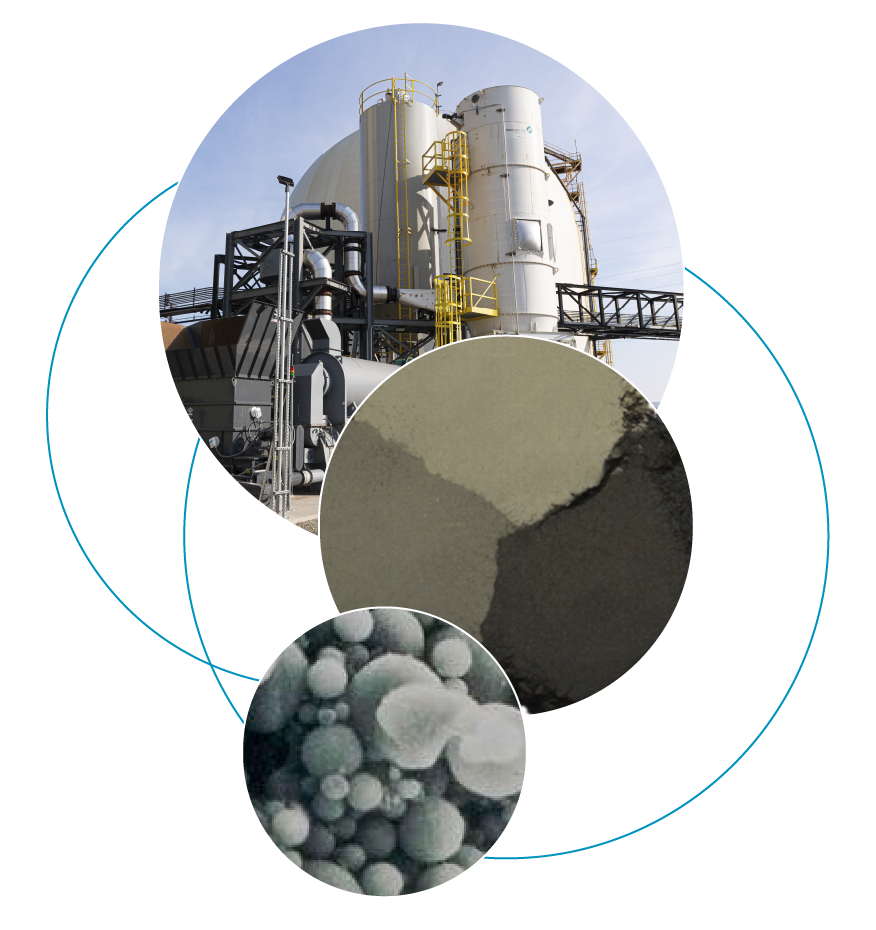
Used commercially since 1995, our completely dry electrostatic separation process for pulverized coal (PC) fly ash beneficiation has generated over 25 million tons of high-quality fly ash for concrete production. Recycled fly ash is an environmentally friendly product used to create concrete with high strength, durability, workability, and reduced heat of hydration.
In use at 12 power stations throughout the United States, Canada, the United Kingdom, Poland, and the Republic of Korea, controlled low-LOI ProAsh® products generated with STET technology have been approved for use by more than 20 state highway authorities, as well as many other specification agencies.
How STET Beneficiates Coal Fly Ash
STET uses a proprietary, industrially proven dry, triboelectrostatic separation process to beneficiate fly ash. The system separates particles based on surface charge differences, allowing carbon to be reduced without adding water or chemical reagents. That matters because many conventional approaches utilize high-temperature thermal combustion, add process complexity, require wet handling, or create a product that then needs to be dried again before shipment or use.
The STET process is continuous and designed for fine particles, which makes it well-suited for fly ash. STET has 30 years of experience operating its separation equipment in industrial settings and has processed over 25 million tons of fly ash. Operating as a non-thermal, water-free system, it helps simplify plant layout, eliminate water-related constraints, minimize impacts to air emissions, and produce a dry product stream ready for use. For coal fly ash applications, the result is a cleaner, more consistent ash product with improved reuse potential at competitive operating and investment costs.
Reasons to Believe
STET electrostatic separation achievements include:
- 25M tons of fly ash has been processed in our history.
- We have enabled the avoidance of >20M tons of CO2 emissions—equivalent to taking 4.3 million cars off the road for a year.
- We have enabled our customers to save over 8.5 billion gallons of water, which is more than 11,000 Olympic-sized swimming pools.
- ProAsh quality has been certified under the ASTM C618, CSA A3001-23 and EN 450.
-
ProAsh produced by our technology is used in some of the most demanding projects, including high rise buildings, bridges, tunnels, and other critical infrastructure.
Unlock Fly Ash Potential with STET
Fly ash beneficiation can improve product value while converting waste to a valuable construction material.
- Improved product quality and consistency: Beneficiation reduces unburned carbon and variability, producing a cleaner, more reliable material for concrete, cement, and other industrial applications.
- Greater beneficial reuse and reduced disposal: More ash can be diverted from landfill into higher-value use, improving sustainability and reducing waste volumes.
- Combustion-free processing: Minimum air emissions make the STET process easier to permit.
- No water. No chemicals: STET’s dry electrostatic process eliminates water usage, wastewater generation, and contamination from chemical reagents.
- Simplified processing and handling: A dry process avoids wet handling and downstream drying, making the product easier to transport, store, and use.
- Continuous, high-rate, single-step process: With processing capacities of up to 45 tons per hour, the STET separator integrates seamlessly into existing workflows with consistent output.
- Reduced operating costs: Lower energy consumption, no landfill costs, and reduced environmental remediation contribute to improved economics.
- Revenue growth opportunities: Turning a waste material into a viable, marketable product creates new revenue streams.
- End-to-end solution: From initial concept to fully permitted and supported plant, STET provides the technology, equipment, services, and support needed to optimize fly ash processing and commercialization.
The STET™ End-to-End Service Model
Putting our know-how to work for you
Evaluate
- Assess customer needs
- Sample testing
- Bench-scale testing
Trial
- Pilot plant trials (in-house at STET)
- Full-service lab testing
- Pilot plant of large sample
- Optimization of prep steps (milling, drying, deagglomeration)
- Market development
Design
- Confirm plant design through pilot plant trials
- Control system design
- Finalize plant design
- Estimate construction, production, and manufacturing costs
Build/Install
- Develop detailed engineering (typically done by a third-party specialist)
- Manufacturing of proprietary parts
- Construction of the plant
Optimize
- Rigorous statistics and design of experiments (DOE) based approach
Marketing and Ongoing Support
- Co-marketing programs of fly ash products
- Maintenance program
- Technical support
- Scale-up as needed
- Warehousing & inventory
FAQs
What is fly ash beneficiation?
Fly ash beneficiation is the process of upgrading fly ash so it meets tighter quality targets and can be used in higher-value applications.
Is coal ash the same as fly ash?
Not exactly. Coal ash is a broader term that can include several ash types. Fly ash is one specific fraction and is the main focus in many beneficiation applications.
How does beneficiation improve ash value?
It improves consistency and removes limiting components, such as excess carbon, so the ash can be used in more demanding markets and applications, including ready-mix concrete.
What industries use beneficiated fly ash?
The most common uses are in concrete and cement, but other industrial applications can also use beneficiated fly ash, depending on the final product properties.


